The religions of man do their best to prepare us for days and times of spiritual significance. Though many adherents do not strictly follow the schedule of their sects, these groups often—with all sincerity—establish systems to guide their followers into times of spiritual preparedness. To that end, many find significance in patterns, leading to the construction of doctrinal and devotional traditions. Read more
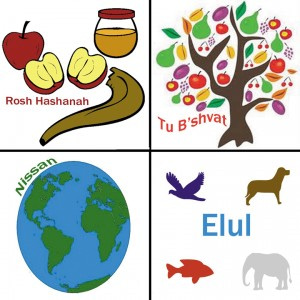
In Judaism, the high holy days of Rosh HaShanah and Yom Kippur are preceded by the month of Elul, a time dedicated to repentance and preparation for the season. Rosh HaShanah—meaning “Head of the Year,” and celebrated as the Jewish New Year—is a solemn day, observed on the first day of the seventh Hebrew month, in the Fall. It is said that on this day, the Book of Life is opened, but will soon be closed again on Yom Kippur, the Day of Atonement. During this ten day period, known as the Days of Awe, it is taught that God makes His decision whether or not one’s repentance will be accepted, and he will be judged worthy to have his name inscribed in the Book of Life. On Rosh Hashanah the shofar (ram’s horn) is blown 100 times, because, according to the Talmud, the loud and repetitive sound of the shofar confuses Satan, preventing him from bringing any charges against Jews during the time of judgment.
Unfortunately, not a single one of these teachings originate with Scripture Read more
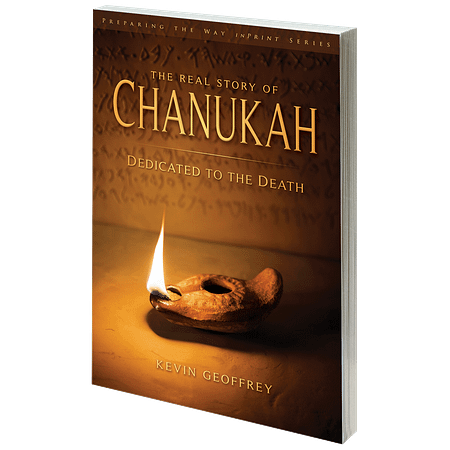
If you have not yet read my book The Real Story of Chanukah: Dedicated to the Death, you may not realize how closely the civil conditions of those days parallel the societal climate in which we presently live. For example, on page 24, I write,
In the political and cultural climate fostered under the “sinful offshoot” Antiochus Ephiphanes [the Greco-Syrian king who occupied Israel], the Jewish people began to test the waters of personal liberty as they explored alternative lifestyles outside of godly boundaries. A vocal, activist, minority within Israel—those who were overtly and shamelessly defiling the Torah—paraded their transgressions before the general population, inciting them also to go astray.
As the story unfolds, we come to find out that such exploration of “personal liberty” and “alternative lifestyles” eventually leads to dire consequences for Israel. Read more
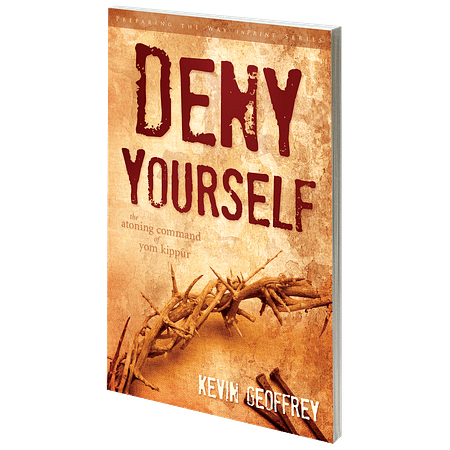
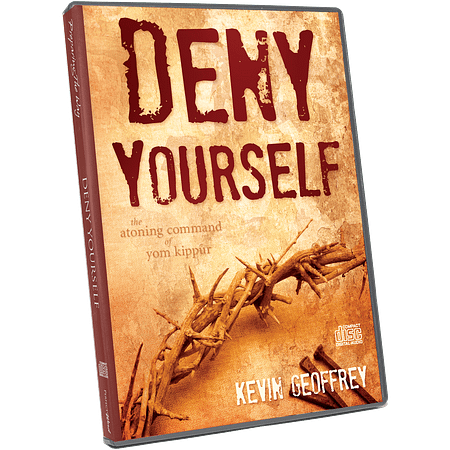
In this powerful, intense, live teaching presented during the Yom Kippur season, Kevin Geoffrey presents the Scriptural mandate for both the holiest day of the year and the daily life for disciples of Messiah: deny yourself. Taken to heart, this message will not only change the way you view Yom Kippur, but it will radically alter the course of your life.
Audio, which was available on Wednesday, September 26, 2012, is no longer available here. Please go here instead.
Yom Kippur… the single holiest day on Israel’s calendar—and it is best observed by doing absolutely nothing… the Master Yeshua, our great high priest, has already done it all! The Yom Kippur command to deny oneself is also the heartbeat of those who live for Messiah, in whom this awesome day is fulfilled. For more about “Deny Yourself” and Yom Kippur:
Q: A friend of mine is reading a book by someone who said there are four calendars we are to operate on Scripturally. Have you ever heard about this?
A: Your friend is correct when he says that Judaism understands there to be four calendars (or “new years”), hence the reason the first day of the seventh month is celebrated as “Rosh HaShanah”—the “head of the year.” With all due respect to the Rabbis, however, such an idea cannot be defended from Scripture.
First, while the phrase Rosh HaShanah does occur in Ezekiel 40:1, it is not in reference to the first day of the seventh month. Second, though Exodus 34:22 says that “the revolution of the year” occurs in the seventh month, the phrase is referring to the Feast of Ingathering, which falls on the fifteenth of the month, not on the first. “The revolution of the year” speaks to the circuitous nature of Israel’s agricultural schedule, the harvests of which begin in the Spring and conclude in the Fall. Then the process of planting, sowing and reaping repeats.
Scripture only mentions one beginning of the year: Rosh ’Chadashiym, which means “Head of the Months” (“Months” is literally “New Moons”). Exodus 12:2 calls it “the first of the months of the year,” referring to the month in Spring known Niysan (Ne.2:1, Est.3:7) or Aviyv (Ex.13:4).
So, despite the historical development of Judaism, Adonai established only one annual calendar for Israel, and it begins with the harvest and new life of Spring.
What do you think? How, if at all, should this affect our observance? Other thoughts?
Sound off below.
As central as Passover is to the history of Israel and the narrative of our faith in Yeshua, those of us who celebrate it tend to do so at the expense of the greater picture. We focus so intently on the event of the seder—and the pomp and ceremony that traditionally surround it—that we fail to adequately prepare our hearts for the annual moment, missing the momentum for the season that Passover begins.
Every year, it pains me to see Passover treated as little more than a date on the calendar, a teaching event, or an evangelistic outreach (in certain Messianic circles). Additionally, I am grieved that many will default to mere attendance at a formal community seder, rather than expend the energy to personally prepare for an intimate remembrance in the home, according to Scripture. It is not because of disobedience, but for the missed opportunity that I grieve—an opportunity that, with only some forethought and effort, can be wholeheartedly embraced. Read more
The most obvious and symbolic element of Chanukah is the ’chanukiyyah (commonly, though inaccurately, called the m’norah), used for the commemoration of the alleged miracle. The chanukiyyah is usually a nine-branched candelabra designed to hold eight Chanukah candles, one for each night, plus the shamash (meaning “servant”). In typical fashion, the shamash is lit, then used to kindle each Chanukah light in turn: on the first night, one light; on the second night, two; and so on, until all eight lights are kindled on the last night of the Festival.
The chanukiyyah, while apparently ancient, is not explicitly prescribed by the Rabbis. Neither is the use of candles as Chanukah lights. Indeed, most of the Talmudic references are to oil lamps. For example, Mas. Shabbath 23a, discusses which kind of oil is best for kindling the Chanukah lights (evidently, it’s olive oil).
But what is truly intriguing about the traditions surrounding the chanukiyyah, is that the most common method used today for kindling the Chanukah lights was originally meant only for the “extremely zealous.” You may be surprised to know that according to Mas. Shabbath 21b, only one Chanukah light per household is “demanded,” and any increase in the number of lights is merely an indication of one’s “zeal.” According to the Rabbis, each household must light at least one Chanukah light per night; for the “zealous,” one light nightly for each member of his household; and for the “extremely zealous,” eight lights—with Beth Shammai saying to reduce the number by one each night, and Beth Hillel maintaining that the lights should progressively increase each night up to eight.
In short, there’s more than one way to kindle the Chanukah lights, and the traditions and rituals are not quite as fixed as we have been led to believe.Read more
In my book about The Real Story of Chanukah, I included a lengthy endnote about Christmas. For those interested in one Messianic Jew’s opinion, here it is in its entirety.
Since this is a significant issue among Messianics and Christians in pursuit of the “Jewish roots” of the faith, I feel that it is worthwhile to offer my perspective on Christmas. Personally, I have no problem with Christians celebrating Christmas. For sure, there are seriously pagan issues with the holiday and its accompanying icons (these facts are widely documented, and, since this is a book about Chanukah and not Christmas, I do not feel compelled to elaborate here), but as far as the Luke 2 tradition is concerned—where the sole and central purpose of celebrating Christmas is the recognition of Yeshua’s birth—I have no problem with it whatsoever. Read more
“A blogger writes about how one of Judaism’s holiest days ended, for her, in a strip club, while elsewhere a guy strolls into a tattoo parlor requesting a Star of David. Two women exchange wedding vows in a Jewish ceremony, and hipsters toss back bottles of HE’BREW, The Chosen Beer…. [Moses] couldn’t have seen these Jews coming.”
This is how a CNN article begins, showcasing the so-called “New Jews” and the ways they express their Jewishness: with flagrant violation of Torah, and a heart ablaze for assimilation. They are “making [Judaism] and its culture work for them and others in a time when, more than ever, affiliation is a choice.” It’s an astute observation by Ms. Ravitz (the article’s author), and one that should make us shudder: it’s happening again—as it has continually since the beginning—Jews choosing… as if we had a choice. Read more
What great nation is there that has a God so near to it, that He would command His people to party for seven days straight? Sukot, the final feast of the year, is a week-long, unabashed celebration of Adonai’s provision, protection and salvation. It’s simplicity and joy lends itself to an unparalleled revelation of Yeshua!
Audio, which was available here from October 13-20, 2011, is no longer available here. Please go here instead. This teaching is part eleven of the 12-part series “Signs & Seasons,” a Scriptural exploration of Israel’s calendar.